

International Certification Of Evidence Of Impact In Education
EduEvidence is a global not-for-profit organization committed to transforming digital education by evaluating and certifying EdTech tools.

PARTNERSHIPS
National Partners and certification providers
We work closely with national governments, municipalities and EdTech Alliances to align local certification schemes with international benchmarks. Our rubrics and criteria, developed as global public goods, are fully adaptable to national contexts while maintaining coherence with internationally agreed standards. Companies certified by our trusted national partners can be automatically re-certified through this alignment. Our expert validators then review the submitted evidence against the international standard and verify its correspondence to the company’s current product version. Together, we are building global comparability and sustainability of shared quality assurance systems.
Companies certified by our trusted partners can be automatically re-certified. Our validators will check your evidence in relation to the international standard and how it corresponds to your current tool (version). The re-certification costs only 250 USD and takes 5-7 business days.
EduEvidence badges reach virtually every K-12 school in the US through our partnership with the EdTech Index and Clever, Classlink, SchoolDay and Lightspeed. They also reach schools through similar providers in Europe (eg Skolon), Asia (Asian EdTech Marketplace), Latin America and Africa.
Want to be on our list of trusted certification providers? Contact us. Want to get certified? Register your product and apply for free.
EVALUATION FRAMEWORK
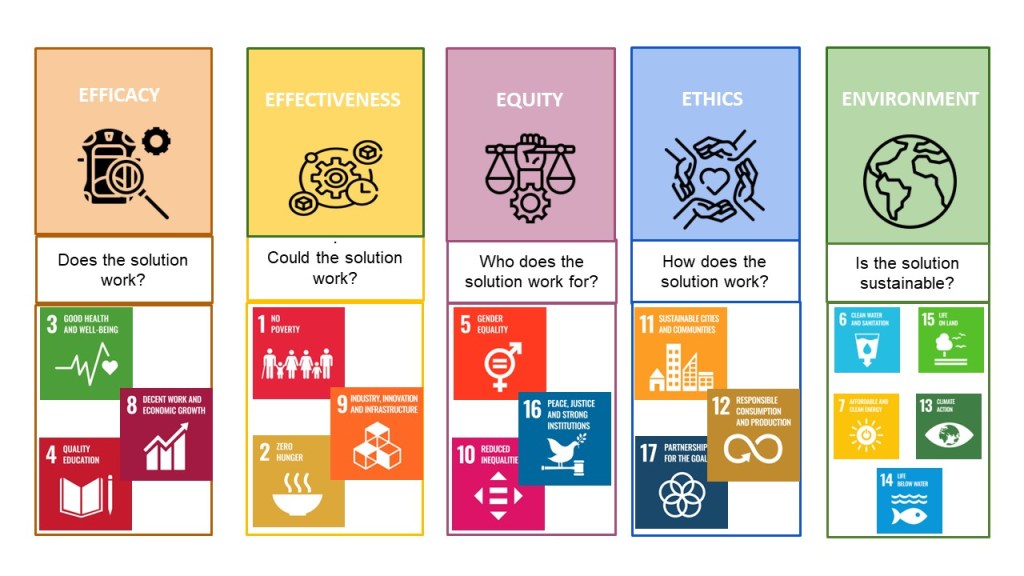
The 5Es of Impact
Efficacy, Effectiveness, Equity, Ethics and Environment
The Multidimensional Impact Framework, crafted by leading scholars, provides a thorough approach to evaluating EdTech tools’ effects on learning outcomes. It blends quantitative and qualitative data with insights from educators and researchers, while also considering factors like cost-effectiveness, ethical practices, equity, and environmental impact. Aligned with the 17 Sustainable Development Goals (SDGs), the 5Es framework, introduced in 2023, provides a comprehensive view of educational technology’s broader impact.
The 5Es framework serves as a benchmark for quality aspirations, not as a legal or regulatory standard.
Equivalence certification system
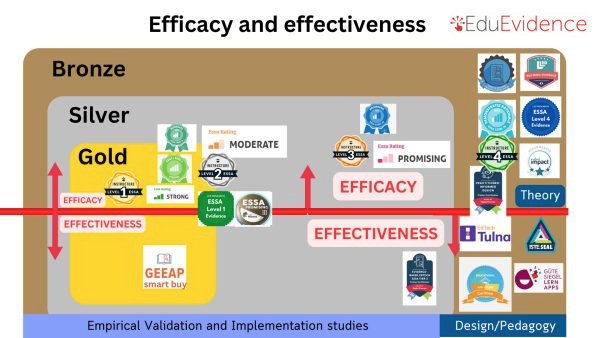
The EduEvidence Team commissioned the International Centre for EdTech Impact (WiKIT) to systematically review all available certifications relevant to EdTech globally and categorize them according to five consolidated benchmarks: Efficacy, Effectiveness, Ethics, Equity, and Environment, as well as three levels: Gold, Silver, and Bronze. The researchers reviewed all publicly available information on these certifications (including their criteria, application procedures, and the rigor of their evaluation systems) and ranked them into three categories: Gold, Silver, and Bronze.
The EduEvidence Equivalence certification system is the world’s first system that allows for direct comparison of solutions certified by individual organizations. This reduces duplication of efforts (companies certified at one level don’t need to be certified again) and facilitates decision-making for procurement teams and policymakers.
Why it matters
Evidence matters more than ever in education technology.
With so many tools claiming impact, a neutral, evidence-based certification helps educators, investors, and policymakers know what truly works.
It builds trust, transparency, and accountability—so that innovation in EdTech leads to real learning outcomes.
Learn more about why you should get certified!
To get started, you can register your company and EdTech product in the global list now – it’s free! Learn how to register here.
Policy-makers
Policy-makers and governments want to know not only the impact on learning outcomes, but also the cost-effectiveness, data protection, and human rights considerations. To meet this need, EduEvidence developed a system that generates a Total Impact Score for each EdTech product before recommending it to national governments. This score is based on a research-driven formula that evaluates multiple impact dimensions, grounded in international standards but tailored to local contexts.
Schools
Schools are faced with thousands of EdTech tools available through app stores, commercial databases, teacher forums, and national catalogues, making it difficult to navigate the vast selection. To simplify this process, EduEvidence developed a Catalogue of Recommended Resources. This catalogue is based on assessing the quality of EdTech tools through rigorous, independent research, verified by third-party evidence—ensuring that schools make informed decisions grounded in solid data rather than marketing claims.
EdTech companies
EdTech companies want to showcase the positive impact they make on learners. They want to highlight user engagement, teacher and researcher feedback, and demonstrate their overall impact. EduEvidence understands this need and has developed a Certification Scheme that is accessible to both startups and established companies. This scheme includes a straightforward badging system across multiple impact areas, providing companies with a clear market advantage by externally signaling their evidence-based practices.
There are more than 70 countries represented in the Eduevidence.org database, and more than 1,500 EdTech products.
The number increases monthly, and an updated list can be found here.

Contact
International Certification of Evidence in EdTech
Over the course of the years, EduEvidence has been engaging in conversations with researchers, the EdTech industry, educators, funders and policymakers to align the evaluation criteria and ensure international comparability. If you are interested in evidence-based decision making in EdTech, we are keen to hear from you.
eduevidence1@eduevidence.org
International Certification of Evidence in EdTech
c/o Validé AS, P.O. box 8600, 4036 Stavanger, Norway
Org no. 932 595 036

